Dragonlance Creatures: Draconians and the Dragons of Krynn
Meet the Draconians and dragons of Krynn: the unique creatures of Dragonlance that made the setting unforgettable for fantasy RPG.
Dragonlance Creatures: Draconians and the Dragons of Krynn
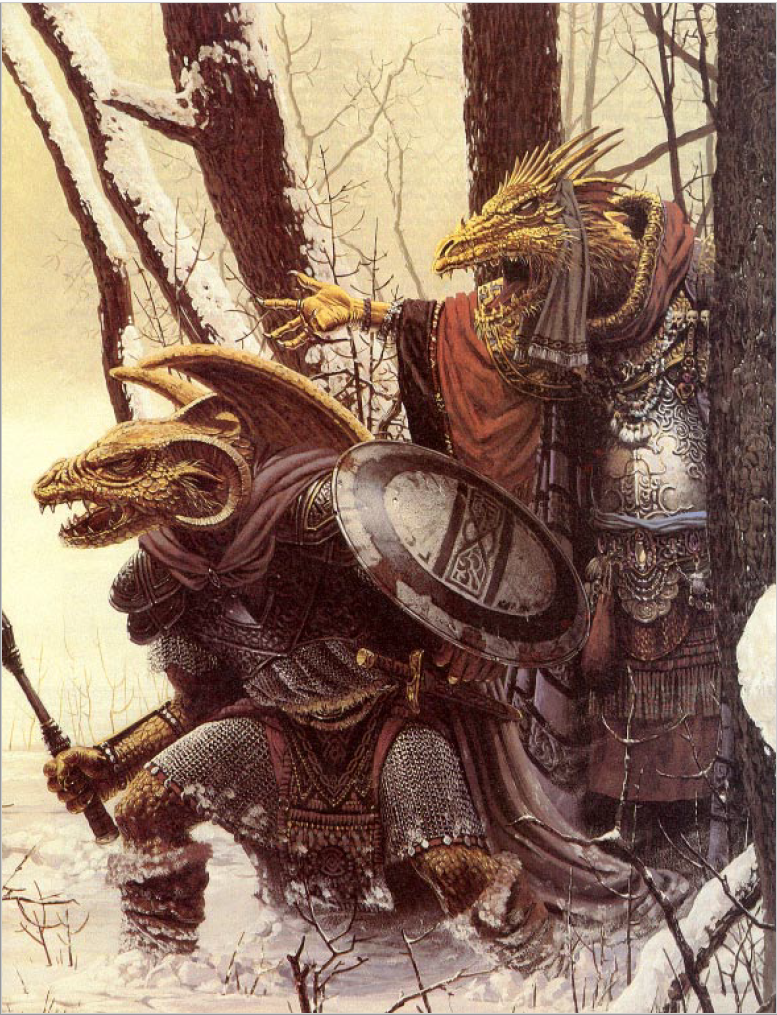
You're in a dark corridor when you hear the scrape of scales on stone floor. The being that emerges from the shadows looks like a dragon — but smaller, bipedal, with wings folded on its back and a sword in its hand. It smiles. You notice the mouth is wet, as if it had licked the blade.
You've just met a Kapak.
And when you finally kill it, the body instantly dissolves into a pool of fuming acid covering all the floor around it. The corridor that was your escape route is blocked. Your ally standing right in the middle of the area starts screaming.
Welcome to the creatures of Dragonlance.
What are Draconians — and why their origin is a war crime
Draconians are the setting's most morally weighty creation. They are not monsters invented to populate dungeons. They exist because Takhisis committed a deliberate act of betrayal before the War of the Lance had even begun.
(See our post on Dragonlance's history to understand the full context of the War of the Lance and the theft of the eggs.)
Here is what happened: the good dragons — gold, silver, bronze, copper and brass — existed in Krynn just as much as the evil ones. Takhisis sent her servants to steal the eggs of these dragons from Dragon Island, hiding them in the bowels of volcanoes. With the eggs as hostages, she demanded that the good dragons take the Oath of Neutrality — promising not to interfere in the war in exchange for the promise that the eggs would be returned intact at the conflict's end.
The good dragons, honorable by nature, kept the Oath. They stayed out of the war.
The eggs, however, were not protected. Takhisis handed them over to an evil trio — the cleric Wyrllish, the mage Dracart, and the ancient red dragon Harkiel. Through arcane rituals, they corrupted the eggs, multiplied their occupants, and opened a portal to the Abyss. The abishai — servants of the Queen of Darkness — invaded the new bodies.
Draconians were born from stolen eggs and corrupted souls. Every Draconian on the battlefield represents a good dragon that was never born.
This isn't just background lore. It's the reason why the heroes of the Chronicles discovering this betrayal is one of the saga's most important moments — and the reason the good dragons enter the war with absolute fury when the truth is revealed.
The five types of Draconians — and how each one dies spectacularly
One of Dragonlance's most creative mechanics is that each type of Draconian has a unique death effect. Killing a Draconian is never simple, never safe, and never forgettable.
Baaz — the soldier that turns to stone
The Baaz is the most common of the Draconians — front-line troops for the Dragonarmies, sentinels, spies disguised under hood and mask in civilized lands. They are chaotic by nature and frequently ignore the chain of command when no one is watching.
When a Baaz reaches zero hit points, its body instantly turns to stone. Whoever struck the killing blow must make a Dexterity check or their weapon becomes stuck in the statue. The statue crumbles to dust a few rounds later — but the timing can be very inconvenient in the middle of combat.
Bozak — the bones that explode
Bozaks are the mages of the Draconians, capable of casting spells as 4th-level magic-users. They are used as special forces and as commanders of Baaz squads. Their preferred spells include magic missile, web, and stinking cloud — selected for area control and for protecting the Baaz around them.
When they die, their scaly skin withers and falls from the bones in a cloud of dust. And then the bones explode, dealing damage to everyone within 10 feet. No saving throw. You killed the Draconian mage. Now run.
Kapak — the acid pool at the worst possible moment
Kapaks are distinguished by their venomous saliva. They lick their weapons before attacking, transmitting paralysis to their victims. They are used as assassins and archers, preferring ambushes to direct confrontation, luring prey into traps.
When a Kapak dies, its body instantly dissolves into a pool of acid 10 feet in diameter. Anyone within the area takes damage each round they remain there. The acid disappears after a few rounds — but the corridor that was your escape route, the tight space where the party was fighting, or the narrow bridge they need to cross can become impassable at the worst possible moment.
Sivak — the shapeshifter that takes your form when it dies
Sivaks are the elite of the Draconian forces, wearing heavy armor and wielding two-edged swords with terrible efficiency. Their most disturbing ability: when they kill a humanoid of the same size or smaller, they can assume the exact form of the victim — perfect appearance and voice — without gaining memories or abilities.
But when a Sivak is killed, it assumes the form of the creature that killed it. This state lasts three days before the body decomposes into black soot. On the battlefield, this means you may have a corpse with your own face staring up at you.
Aurak — the general that doesn't die the first time
Auraks are the rarest and most powerful — generals and special agents with no wings but with limited teleport. They can turn invisible, polymorph into humans with perfect voice, control minds, and cast mage spells. They are virtually impossible to identify when infiltrated into human populations.
When they reach zero hit points, Auraks do not die. Instead, they wrap themselves in green flames and enter a combat frenzy with attack and damage bonuses — and anyone who attacks them takes damage from the flames. Six rounds later they transform into a lightning ball that attacks automatically. Three rounds after that they explode, dealing damage to everyone within 10 feet, no saving throw, stunning survivors.
Killing an Aurak is a three-stage process with a countdown. It is possibly the most satisfying and most terrifying enemy mechanic in all of fantasy RPG.
Practical tip: Never use only one type of Draconian in an encounter. A Bozak commanding Baaz with a Kapak flanker turns combat into a tactical puzzle: who to kill first, in what order, and where to stand when the body falls. Every decision has an immediate spatial consequence.
The other unique creatures of Krynn
Draconians are the most iconic, but Krynn has its own bestiary worth paying attention to.
Thanoi, or Walrus Men, inhabit the frozen regions of Icewall. Human-walrus hybrids — with enormous tusks, padded feet and arms capable of wielding weapons — they are cruel creatures that often kill for pleasure. Immune to cold but vulnerable to heat, they lose a hit die per week in environments above freezing. The thanoi domesticate Ice Bears to track prey over snow and ice with frightening precision.
Shadowpeople have inhabited Sanction since before the Cataclysm. Covered in dark fur, with membranes that allow them to glide through the air, they are telepathic mammals that suffer in lit environments. In combat they use curved hooks that continue dealing damage each round after impaling an opponent. Their ESP ability makes them impossible to surprise by any sentient creature.
Spectral Minions are spirits of mortals who died before completing vows or missions, forced to relive their final moments for eternity. There are six types: Guardians waiting for passwords no one knows anymore, Philosophers debating texts in libraries for centuries, Revelers whose spectral parties have a dangerously hypnotic effect on the living, and Warriors trapped in endless battles. Each type requires a different approach to be released — and some simply cannot be.
The Fetch may be the most frightening creature in Krynn's bestiary. Existing on the margins of the Abyss, it can only reach the world through reflective surfaces — mirrors, pools of still water. It appears as a pale, sickly version of whoever is looking, positioned immediately behind them in the reflection. It is invisible to everyone except its victim. It drains two experience levels per hit. And the victim can only see it by looking at the reflection, which means combat happens with your back to the enemy, with an attack penalty.
The dragons of Krynn — personalities, histories and the weight of their choices
Krynn's dragons are not generic bestiary monsters. Each type has a defined personality. And many have names, histories and specific roles in the saga that make them characters in their own right.
The evil dragons and their roles in the war
The red dragon Ember served Highlord Verminaard and was responsible for the destruction of Solace and the fall of Pax Tharkas. Red dragons are the most ferocious of all dracokind — over 48 feet long, exceptionally intelligent, and completely devoted to the Queen above any human Highlord.
The blue dragon Skie was Kitiara's companion and became famous among his kind for an unusual loyalty to the female knight. Blue dragons are the most gregarious of the evil dragons, capable of operating in coordinated units — which made them the primary instrument of assault against fortresses during the war.
The green dragon Cyan Bloodbane was responsible for blowing nightmares into the ears of King Lorac of Silvanesti, transforming the entire elven forest into a living nightmare that lasted for years. After the war, he served Raistlin himself for a time. Green dragons prefer trickery and magic to direct confrontation — which makes them particularly difficult antagonists to fight head-on.
The black dragon Onyx guarded the Discs of Mishakal in the ruins of Xak Tsaroth — the Companions found her there. Black dragons inhabit swamps and dungeons, cover their movements with the darkness spell, and rarely participate in direct military operations due to their independent nature.
The good dragons — and why they stayed out
Krynn's good dragons are perhaps even more tragic characters than the evil ones. They kept the Oath of Neutrality throughout the initial war — watching the world burn while their eggs were used to create Draconians — and only entered the conflict when the betrayal was discovered.
Dargent, the silver dragon, met the Companions in the form of a Kagonesti elf named Silvart. Sister of the silver dragon who fell in love with Huma millennia before, Dargent was destined for an equally tragic love — this time with Gilthanas, lord of the Qualinesti elves, who could never accept her true form.
Khirsah, the bronze dragon, became known as Tasslehoff's Dragon — the only one of her kind who allowed a dwarf or a kender to ride on her back. A distinction that bronze dragons generally consider entirely beneath their dignity.
Pyrite, the oldest gold dragon in Krynn, was the companion of old Fizban. Deaf, nearly blind, grumpy and senile, Pyrite remembered the glorious days of Huma with far more clarity than any recent event — which caused regular confusion when called to battle.
Brass dragons are excessively talkative and will follow groups of adventurers for hours just for the pleasure of conversation. Copper dragons are good by nature but almost always ask what they get out of it before helping. Gold dragons rarely polymorph into humans, considering the diminutive form unworthy.
Takhisis and Paladine in dragon form
At the top of Krynn's draconic hierarchy stand the gods themselves.
Takhisis in her favored form is a five-headed chromatic dragon — over 60 feet long, each head with its own color, breath weapon and personality. Ice, poison gas, lightning, fire and acid can all be used simultaneously. Each head can cast spells independently from the others at the same time. Encountering her in this form is a campaign event, not a standard combat encounter.
Paladine in dragon form is the Platinum Dragon — over 72 feet long, capable of breathing ice, steam that transforms victims into gaseous form, or sonic vibration that disintegrates solid rock. His preferred form, however, remains that of a bumbling old mage with a crooked hat and pockets full of dirty socks.
How to use these creatures at your table
Dragonlance has enough creature material for an entire campaign without repeating a single encounter. The D&D 5e sourcebook brings updated versions of Draconians and Krynn's dragons with statistics for modern mechanics — including the Draconians' death effects adapted to the current system.
For maximum immersion in battles — especially to visualize the Kapak acid pools, the Bozak explosions, and the dragons in flight — a good battle map completely changes the visual dynamic of the table.
And to read the original adventures where Draconians appear for the first time — with Ember burning Solace, Onyx guarding the Discs of Mishakal, and the good dragons entering the war with accumulated fury — the Chronicles are where that story begins.
Practical tip: The most powerful narrative reveal a Game Master can make in a Dragonlance campaign is letting the players discover for themselves where Draconians come from. When they realize that every enemy they killed was a corrupted good dragon egg — the tone of the campaign changes completely.
Dragonlance's creatures exist for reasons — historical, moral, narrative. Every encounter tells a story that goes beyond combat.
(See our post on Dragonlance's history to understand how Draconians fit into the betrayal that defined the entire War of the Lance.)
Which creature of Krynn do you most want to face — or desperately want to run from? The Fetch that appears in your own reflection? The Aurak that doesn't die the first time? Tell us in the comments and share it with your group. The next session might start right there.
Recommendations
Related books & products
D&D: Dragonlance — Shadow of the Dragon Queen
Aventura oficial da Wizards of the Coast ambientada em Krynn.
D&D: Dragonlance — Shadow of the Dragon Queen (Deluxe)
Edição deluxe com extras exclusivos para mestres.
Kit 7 Dados RPG Vermelho + Bolsa de Veludo
Dados com runas e bolsa de veludo para guardar com estilo.
As an Amazon Associate, I earn a small commission from qualifying purchases — at no extra cost to you.
Posts relacionados
Dragonlance Gods: Complete Guide to Krynn's Pantheon
Meet the gods of Dragonlance: Paladine, Takhisis, Mishakal and all 21 gods of Krynn. The pantheon that shaped the entire history of the setting.
Dragonlance Magic Items: Complete Guide to Krynn's Artifacts
Discover Dragonlance's magic items: Dragonlances, the Staff of Magius, Dragon Orbs and more. The artifacts that defined Krynn.
Dragonlance Characters: The Icons of Krynn
Meet the characters of Dragonlance: Raistlin, Tanis, Kitiara, Lord Soth and more. The icons who made Krynn unforgettable.
Comments
Loading comments…
Log in to leave a comment: