RPG: The Hobby That Got You Hooked Without Warning
RPG is improvisation, collaborative storytelling and creative chaos with dice. Understand the hobby that's winning over more and more people — and why.
What Is RPG? A Complete Guide for Beginners
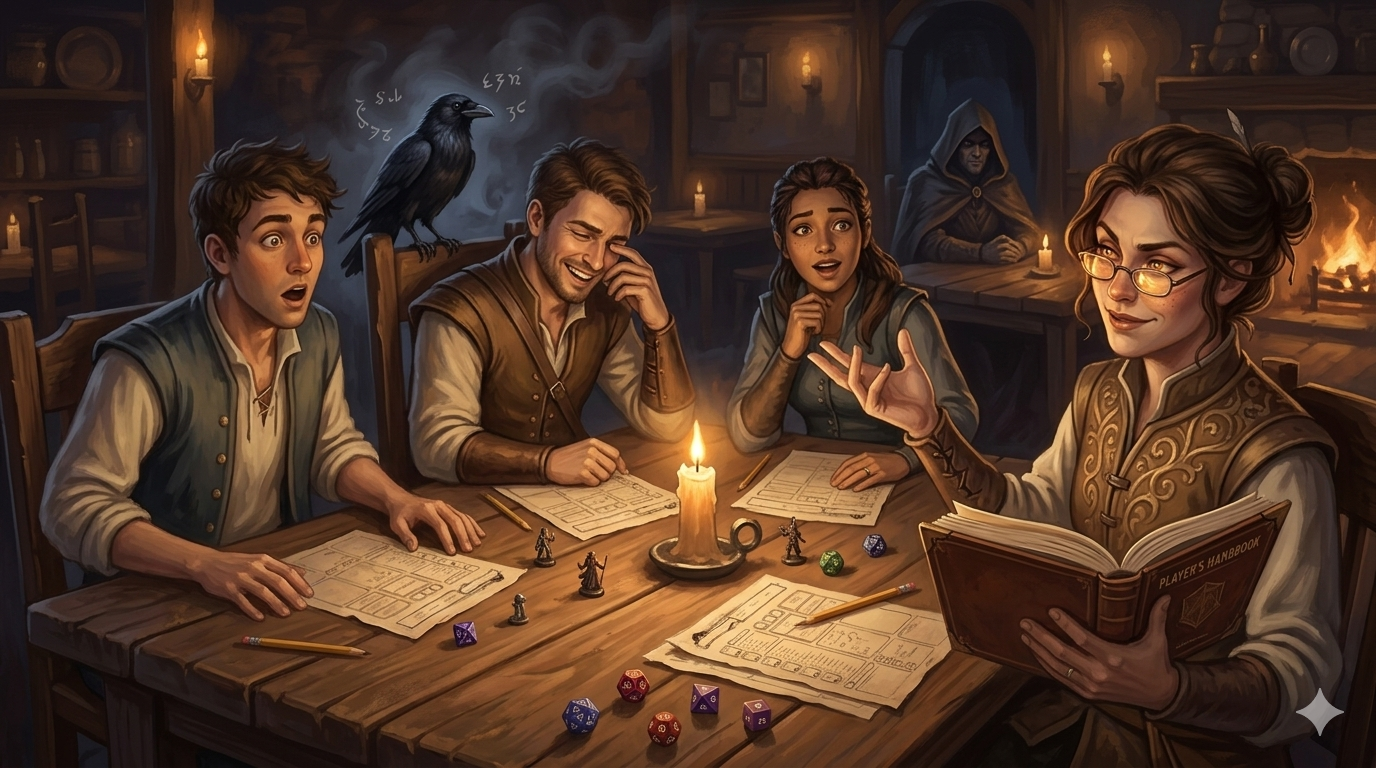
Imagine sitting with friends around a table covered in scattered dice, a hand-drawn map on paper and someone with a dramatic voice saying: "The dragon spreads its wings and breathes fire in your direction. What do you do?"
That's RPG. And yes, it's as epic as it sounds.
If you've arrived here without knowing what RPG is — Role-Playing Game — get ready: this might be the gateway to the most creative, social and addictive hobby you'll ever find. No exaggeration.
In this guide you'll understand everything from scratch: what tabletop RPG is, how it works, where to start and which materials are actually worth it.
What is tabletop RPG and how does it work in practice?
Tabletop RPG is a cooperative game where participants create characters and live out adventures within a story narrated by one of the players — the famous Game Master (or Dungeon Master in D&D, Storyteller in Vampire).
Think of it this way: it's like improvising a collective film with friends, except you decide what your character does. Want to try convincing the city guard with an epic speech? Roll the dice. Want to scale the castle wall at 3 AM? Roll the dice. Want to punch a goblin that annoyed you? Roll the dice and pray for a natural 20.
Dice are the arbiter of luck — the element of surprise that makes every session unique. At a tabletop RPG table, anything can happen, and that's exactly what makes the hobby so addictive.
The story is created in real time: the Game Master describes the world, presents the challenges and plays the secondary characters (the famous NPCs). The players react, make decisions, and the consequences shape the narrative. It's interactive literature, improv theater and strategy game all in one.
Practical tip: There's no "playing it right." The goal isn't to win — it's to create a memorable story together with the group. Sometimes the mission goes epically wrong, and that becomes the most remembered moment of the entire campaign.
What's the difference between tabletop RPG, video game and LARP?
This is one of the most common questions from people discovering the hobby. You've played The Witcher, Baldur's Gate or Final Fantasy, right? Those are also RPGs — but video game ones.
The main difference is creative freedom. In a video game, what you can do is limited by the programmer's code. In tabletop RPG, the limit is imagination — and the group's common sense.
Want to try bribing the main villain instead of fighting? You can. Want to convince a dragon that you're distant relatives? Technically you can try. The Game Master will ask for a persuasion roll and who knows, maybe you'll roll a 20?
LARP (Live Action Role-Playing) is RPG "live": players wear costumes and physically portray their characters, like an improvised theater piece. It's incredible, but requires another level of commitment — and sewing skills.
Tabletop RPG sits in the perfect middle ground: all the freedom and creativity of an epic story, without needing to sew a leather armor.
How to start playing tabletop RPG from scratch: step by step
Starting RPG can seem intimidating when you see a character sheet full of numbers and abbreviations. Take a breath. It's much simpler than it looks — and the learning curve is fun.
1. Choose a rules system
The system is the set of rules that defines how the game works. The most popular ones are:
- D&D 5e (Dungeons & Dragons 5th edition) — the most famous in the world, great for beginners, with enormous community support
- Pathfinder 2e — a robust alternative with deep character customization
- Vampire: The Masquerade — for those who prefer drama, politics and bites on the neck
- Call of Cthulhu — Lovecraftian horror, investigation and existential madness guaranteed
For most newcomers, D&D 5e is the most natural entry point.
2. Assemble a group
RPG is a social game by nature — you need other people. Ideally between 4 and 6 players, including the Game Master.
Don't have friends who play? Facebook groups, Discord servers and Reddit communities (r/lfg, r/DnD) are full of people looking for exactly that.
3. Create your character
This is where the real fun begins. You'll choose race, class, attributes and — most importantly — your character's personality. Is she a tough warrior with a soft heart? An arrogant wizard with a secret fear of spiders? Go deep. The most memorable characters have flaws.
4. Play your first session
The first session is always a trial adventure (one-shot or session zero). There will be wrong rules, dice falling on the floor and someone accidentally breaking their character build. That's part of it — and it'll become a funny story later.
(Check our post on how to create a character in D&D 5e for a detailed step-by-step guide)
Dice, books and accessories: what you really need to play RPG
Technically, you can play RPG with paper, a pen and a six-sided die. But part of the hobby's charm lies in the accessories — and some really do make a difference at the table.
The dice
The classic RPG set has 7 polyhedral dice: d4, d6, d8, d10, d12, d20 and d%. You can use dice apps on your phone, but holding a d20 at the decisive moment has a completely different feel.
The rulebooks
For D&D 5e, the Player's Handbook is the indispensable base material. It brings all the rules, races, classes and spells you need to create and play any character in the game.
Accessories that make a difference
The Game Master's Screen is an accessory that seems superfluous until you see the Game Master hiding behind it with an evil smile while rolling "secret" dice. Then you understand everything. It brings useful rule references for quick consultation during the session.
Battle maps, miniatures and laminated character sheets complete the setup — but all of this is optional. Start simple and add more as your taste for the hobby grows.
Practical tip: Don't buy everything at once. Start with a set of dice and the basic rulebook for the system you've chosen. The rest you naturally incorporate as you play more — and as the addiction deepens.
Why play RPG: the benefits nobody tells you about
Here's a truth that people outside the hobby rarely realize: tabletop RPG develops real, concrete skills.
Communication and improvisation: you learn to think fast, articulate ideas under pressure and work as a team toward common goals. These are valuable workplace skills — and you develop them while slaying goblins.
Empathy and perspective: playing a character with different origins, values and fears from your own broadens your worldview in a way that few hobbies can. RPG players tend to be better at putting themselves in other people's shoes.
Creativity and storytelling: those who become Game Masters quickly discover a passion for creating stories, worlds and memorable characters. Many writers and screenwriters started exactly this way — building improvised adventures on weekends with friends.
Logical reasoning: calculating attribute bonuses, managing hit points, planning tactical actions in combat — all of this requires reasoning. Children who play RPG often develop these skills without realizing they're "studying."
And at the end of the day? It's simply fun. Spending hours with friends creating absurd memories that become stories told years later — "remember when the rogue tried to rob the king and rolled a 1 twice in a row?" — is priceless.
Where to find free resources and groups to play RPG
Access to the hobby has never been easier. Tabletop RPG has exploded in recent years, in large part thanks to shows like Critical Role — the live-streamed campaign that introduced the game to millions of people who had never heard of it.
Free resources to get started:
- D&D Basic Rules: the basic rules for D&D 5e available for free on the official Wizards of the Coast website
- YouTube: channels like Dungeon Dudes and How to Play offer excellent tutorials for absolute beginners
- Podcasts: actual play podcasts like The Adventure Zone are great for listening and learning
Platforms to play online:
Don't have a local group nearby? Roll20 and Foundry VTT allow you to play RPG over the internet with virtual maps, digital dice and automatic character sheets. They're perfect for those in smaller cities or who prefer playing from the comfort of home.
Active communities:
- r/lfg and r/DnD on Reddit — thousands of players, open tables and sessions for beginners
- Discord servers dedicated to RPG — discussions, questions and groups looking for players
- Facebook groups by system
(Check our post on the best platforms to play RPG online for a complete guide with setup tips)
Now you know what tabletop RPG is — and you're probably feeling that urge to call your friends and schedule a session.
If you have any questions about which system to choose, which dice to buy first or how to find a group, leave them in the comments below. The RPG community is one of the most welcoming there is, and beginners are always welcome.
Share this post with that friend you know will love the hobby — but doesn't know it yet. 😄
And to keep exploring, check out our posts on how to create a character in D&D 5e and the best RPG dice to buy this year.
Recommendations
Related books & products
D&D: Starter Set — Heroes of Borderlands (2024)
Kit completo para quem quer começar a jogar D&D do zero.
D&D: Player's Handbook 2024 (EN)
O novo Manual do Jogador revisado com as regras atualizadas de D&D 5e.
Conjunto 7 Dados RPG — Preto com Dourado Perolado
Os dados mais vendidos no Brasil, perfeitos para qualquer mesa.
As an Amazon Associate, I earn a small commission from qualifying purchases — at no extra cost to you.
Comments
Loading comments…
Log in to leave a comment: